King Hackosam · Weekly Letters
Get two weekly letters on human potential, purpose, and psychology-driven growth. Join 100s of Geniuses becoming who they were created to be.
The Hidden Reason You Feel Empty and Outside of Your Identity Even When Everything Looks Fine
There are two questions that quietly follow almost every human being, whether they acknowledge it or not.
Is this really my life?”
What is really my identity?
It rarely arrives when everything is falling apart.
More often, it appears when everything seems to be going well.
The promotion finally comes.
The business begins to grow.
The family is proud.
Friends congratulate you.
Your photographs suggest that life is unfolding exactly as it should.
Yet, beneath all of it, something refuses to settle.
You cannot explain it because there is nothing obvious to complain about.
From the outside, your life looks successful.
From the inside, it feels borrowed.
That feeling is often dismissed as ingratitude.
It is not.
It is one of the deepest psychological signals a human being can experience.
It is the quiet recognition that you have become competent at living a life you never consciously chose.
Most people mistake this feeling for a lack of motivation.
Others call it burnout.
Some call it a midlife crisis.
I think they are describing the symptoms while missing the disease.
The disease is disconnection.
Not from other people.
From yourself.
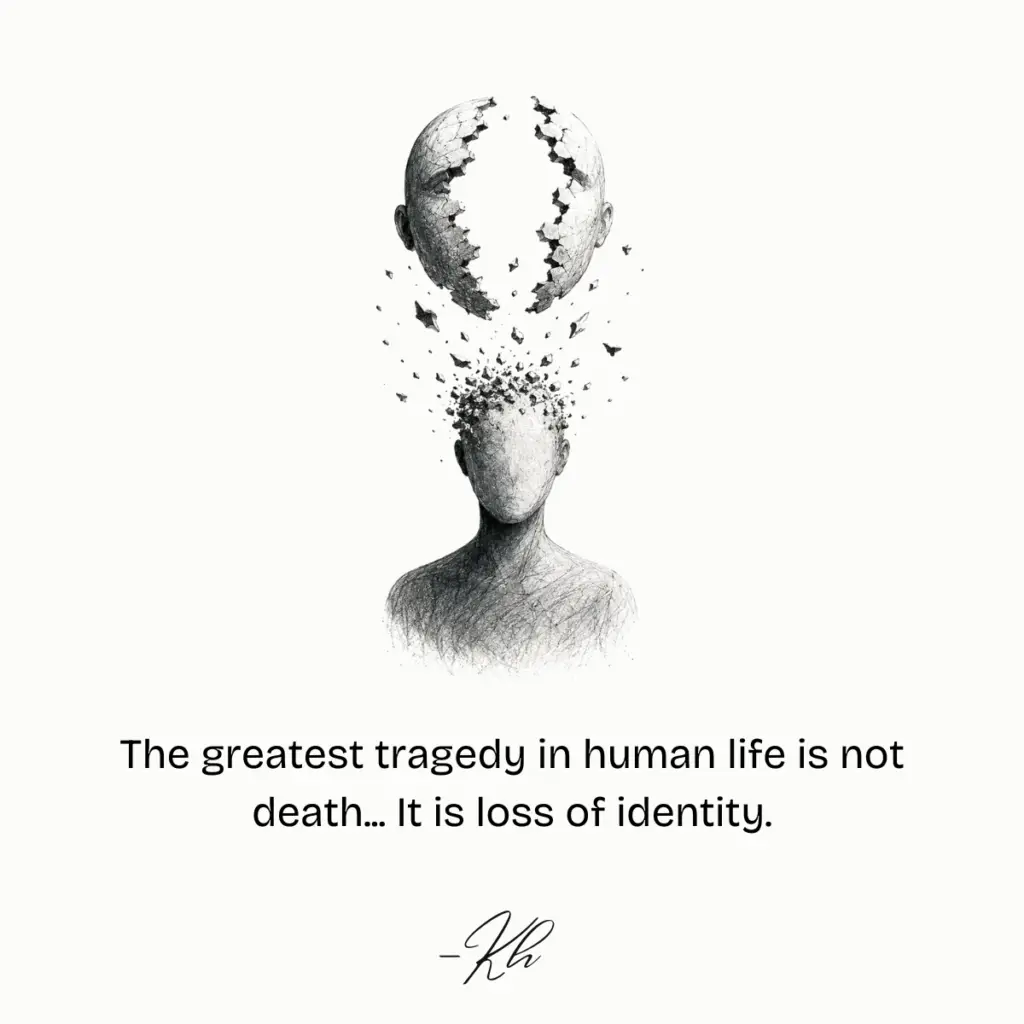
The greatest tragedy in human life is not death... It is loss of identity.
It is reaching the end of your years only to discover that the person who lived them was someone you constructed to survive rather than someone you discovered to express.
This tragedy begins much earlier than most people realize.
Long before you learned mathematics, history, or science, you were learning something far more influential.
You were learning who it was safe to become.
Children are astonishing observers.
Long before they understand language, they understand approval.
They notice which behaviors are rewarded.
Which emotions make adults uncomfortable.
Which questions are welcomed.
Which parts of themselves receive smiles and which receive correction.
Without realizing it, they begin editing themselves.
Not because they are dishonest.
Because belonging is essential to survival.
Psychologists have long understood that human beings are not born with an independent identity. Identity is built through interaction. We discover ourselves partly by seeing how the world responds to us.
The problem is that the same process that helps us survive childhood can quietly imprison us in adulthood.
You begin to confuse acceptance with truth.
If enough people applaud a version of you, it becomes difficult to question whether that version is real.
This is how borrowed lives are formed.
Definitely not through force.
Through repetition.
One expectation becomes another.
One compromise becomes another.
One performance becomes a personality.
Eventually, you no longer remember where the performance ended and where you began.
That is why so many adults feel strangely disconnected from themselves.
It is not because they have no identity.
Because the identity they possess was assembled from expectations they never examined.
Society has an efficient way of rewarding imitation.
Think about how often you have been praised for fitting into a system rather than questioning it.
You are encouraged to pursue respectable careers, desirable lifestyles, socially approved ambitions, and definitions of success that already existed before you arrived.
There is nothing inherently wrong with any of those things.
The danger lies in accepting them without first asking whether they belong to you.
Very few people are taught to ask that question.
Instead, they inherit goals.
Then they spend decades pursuing them.
Imagine climbing a mountain for thirty years only to discover it was never your mountain.
The exhaustion would not come from the climb.
It would come from the realization.
Many people live exactly that way.
Their calendars are full.
Their bank accounts may be healthy.
Their achievements are real.
Yet they cannot answer a simple question without hesitation.
If nobody expected anything from you, how would you choose to live?
That question is unsettling because it separates desire from conditioning.
Conditioning is one of the most invisible forces in human psychology.
It rarely announces itself.
It simply becomes normal.
You inherit your culture’s fears.
Your family’s ambitions.
Your community’s definition of success.
Your generation’s anxieties.
Eventually, they stop feeling inherited.
They begin feeling like you.
But inherited beliefs are not the same as chosen convictions.
There is a difference between carrying an idea and owning it.
The first happens automatically.
The second requires awareness.
This is why awareness is so disruptive.
It interrupts autopilot.
It asks questions conditioning never wants answered.
- Why do I want this?
- Who taught me that?
- Would I still choose this if nobody applauded it?
Those questions are dangerous.
Not because they destroy your life.
Because they expose it.
Many people fear silence because silence asks those questions.
Busyness protects them from hearing the answers.
Distraction has become one of the most socially acceptable forms of avoidance.
We admire people who are constantly occupied.
We rarely ask whether they are occupied with the right things.
Activity can become anesthesia.
As long as you keep moving, you postpone meeting yourself.
The tragedy is that the world rewards movement more quickly than meaning.
It is entirely possible to become highly successful at expressing someone else’s design.
History is filled with people who achieved extraordinary things while quietly abandoning themselves.
The world called them accomplished.
Their inner life called them absent.
Your design is not merely what you enjoy doing.
It is the unique pattern through which you naturally perceive reality, solve problems, create value, and contribute to humanity.
Talent is only one expression of that design.
Curiosity is another.
Your deepest frustrations often point toward it.
The work that leaves you energized instead of depleted often points toward it.
The questions you cannot stop asking point toward it.
These are not accidents.
They are signals.
Unfortunately, most people have spent so many years responding to external expectations that they have forgotten how to recognize internal signals.
They trust applause more than intuition.
Recognition more than resonance.
Popularity more than peace.
Yet the deepest satisfactions in life rarely come from applause.
They come from congruence.
Congruence is what happens when your inner life and your outer life stop arguing with each other.
When what you do reflects who you are.
When your work becomes an expression instead of a performance.
That is why fulfillment cannot be purchased.
It cannot be borrowed.
It cannot be inherited.
It can only be lived.
This is also why comparison is such a destructive habit.
Comparison assumes that another person’s design should become the standard for your own.
Nature has never worked that way.
An oak tree does not compete with a river.
The river does not envy the mountain.
Everything in creation fulfills its purpose by becoming more fully itself.
Only human beings believe they must become someone else before they can become valuable.
Perhaps that is because we confuse visibility with significance.
The loudest life is not always the deepest one.
The most admired life is not always the most meaningful one.
There are people whose names history will never record, yet whose lives were lived with remarkable integrity because they refused to betray their design.
There are also people history celebrates who spent their final years wondering why success never brought peace.
The difference was never opportunity.
It was alignment.
You are not liberated the day you become successful.
You are liberated the day you no longer need to become someone else to feel worthy.
That kind of freedom cannot be given to you.
It must be discovered.
Slowly.
Honestly.
Often painfully.
Because every step toward your true design requires leaving behind an identity that once protected you.
You will disappoint certain expectations.
You will outgrow certain relationships.
You will question ambitions you once defended.
You may even grieve the years spent chasing a life that was never yours.
That grief is not failure.
It is evidence that awareness has begun.
And awareness is always the beginning of freedom.
Perhaps this is why I keep returning to the same conviction.
Not because it sounds profound.
Because I believe it explains more human suffering than we are willing to admit.
Most people are not unhappy because they lack opportunity.
They are unhappy because they have become remarkably skilled at living someone else’s design.
The work of a lifetime, then, is not becoming extraordinary.
It is becoming original.
Returning to the person beneath the conditioning.
Rediscovering the design beneath the performance.
Living from the inside out rather than the outside in.
That journey is neither quick nor comfortable.
But it is the only journey that ends with peace.
Because there is a unique kind of fulfillment reserved for those who finally stop asking,
“How do I become like them?”
and begin asking,
Who was I before the world told me who to be?
That is where your life begins.
Not the life you inherited.
The one that has been waiting for you all along.
– King Hackosam
“If you are not living your TALENT, you are living on a random template of life.”